The link between corruption & early stage venture returns in India

Standard

As everyone knows, venture returns are determined by building innovative products and services that reach scale. The operative words being INNOVATIVE and SCALE. Stuff that has not been built or tried before, stuff that delivers much greater “value” to the customer. We also know that India early stage returns have not exactly been stellar. I’ll present one framework here which tries to link corruption to the challenge in venture returns.

I think everyone knows that the Indian consumer (and business customer) is very price sensitive. The question is why? I think in order to understand this, one needs to understand the concept of opportunity cost. Let me explain it through a small personal story. We had our first child in San Francisco and very close to our apartment there were good, but slightly more expensive, grocery stores. My wife and I would have to make a choice: should we spend extra 30-45 mins for groceries to get the cheapest price or pay the higher price but get that extra time with our daughter. More often than not we’d choose paying more because time everyday was finite and we wanted to get a lot done at home and at work. In other words, we appreciated “opportunity cost” – that our lives could be a little better by spending some money to get extra time at home. And there were similar examples where we’d spend the money so we could be more productive at work (and an implicit understanding that in the longer run that extra investment had greater returns). This was not always the case; growing up in India we were taught to be extremely price conscious. Pre-1991 reforms if you did not have a family business and worked for a public or private sector company, there was a very high correlation between age and salary. That was the result of a closed, license-raj driven economy. What that told the average worker is that no matter how hard you try your “topline” cannot grow all that much so the logical thing for each person to do was to really focus on cost management in order to get financial security. These behaviors were drilled into the Indian psyche for decades and such behaviors which have achieved scale are very hard to unravel. On the other hand, in an environment where your “topline” can grow rapidly depending on how hard & smart you worked, there is all the incentive to focus time and energy on growing the “topline” rather than cost management.

As the Indian economy opened up & wages rose, we have seen much higher levels of consumer spending. The challenge however has been that the habits of the past have been hard to break. While opportunity costs have risen, the appreciation of opportunity cost by a large percentage of the population will take multiple generations.

But the other big challenge in appreciating opportunity cost is also the quality of the day to day interactions. The reality is that daily interactions are very poor even today and therefore trust is very low. The bribery scandals, the rape cases, the worsening infrastructure, the hassles of dealing with law enforcement, etc all negatively impact a consumer’s trust. All of these in one way or another have roots in the corruption in the system: The roads are poor and not improving fast enough because there is huge wastage of invested capital due to corruption in the system; traffic indiscipline is getting worse because law enforcement is not consistent or reliable – drivers break the rules with impunity … etc. In the end all these examples are rooted in corruption and not having a common set of rules that everyone trusts and abides by. This then has an impact on consumer’s willingness to try something new or pay more for greater value: “will it work?” , “what new hassles will it bring?”, “can I trust this company?” , “I don’t believe this will have the impact promised!”, etc. The default trained mindset is to focus on what you can get today because who really knows what will happen tomorrow. The consumer is just trying to make his/her life better and protect his/her loved ones the best they can; this is not a “cultural” thing, it is a systemic thing and quite frankly the biggest failure in India has been our inability to root out corruption. In other words, extreme price sensitivity is an expression of lack of hope.

With that background let me come back to the topic of this post and connect the dots between corruption and venture returns. Here is how I see it:

corruption in the system -> daily poor experiences -> lack of trust/hope -> lack of appreciation of opportunity cost -> extreme price sensitivity -> no value for high order products/services -> work is primarily dictated by operational complexity (not innovation) which is not very valuable -> poor returns for early stage investors 

What do you think? Valid connection?

My final comments on a Twitter discussion about design & India focused startups

Standard

Here’s the starting point of the discussion on Twitter:

Just to summarize my thought: the original referenced article talked about design being a key pillar of a startup. My contention is that that is a developed market centric view which should be applied carefully to India focused startups. It is first more important to understand the consumer’s concerns & see how design fits in there. Saying that the design sense of the Indian consumer is “not evolved” is saying that consumers haven’t yet caught up – that’s wrong. It is not the consumer’s job to “catch up”, it is the job of a company to understand what are the drivers of earning the consumer’s business. Design has become such an important differentiator in developed markets because consumer does not have issues of systemic trust.

None of this is suggesting that design is not important. But as entrepreneurs we need to allocate capital and resources correctly and figuring which problems are the biggest drivers is critical to that exercise. Design, IMHO, comes after trust has been earned, after operations are smooth … it is not a 1st order concern.

Sense of aesthetics is also fundamentally affected by surroundings: garbage on the roads, construction everywhere; the average consumer’s desire in India is just to have things work and be clean. Aesthetics is not yet a mass concern. Think of the online banking site of any Indian bank – from global standards of UI/UX they are horrible. In fact the one I use (large well known bank) is downright buggy and randomly logs me out. This has not been fixed in over 6 years; 6-long-years! You’d think this would be the death knell for the bank. But they have retail locations everywhere, they advertise heavily and for an average consumer that solves the first order problem: this bank will not run away with my money or go down tomorrow.

Take a look at these two great posts that came up in the Twitter discussion:

In short: when doing business in Rome, study Rome.

Q: Will Marketplaces Work in India? A: No.

Standard

Longer answer:  The poor quality of subsystems, supply chain & infrastructure is such that the best case is that marketplaces will take time to deliver a quality experience to consumers and therefore will take time to scale and reach meaningful profitability.

I have been quite excited by Uber’s launch in Bangalore. For anyone who has haggled with auto-rickshaw drivers and been ditched last minute by every call-taxi service, Uber’s commitment to providing a high quality on-demand experience is a welcome disruption. And yet I worried about how they will execute in India. As in developed markets they are choosing to integrate local cab companies and don’t quite have control over quality of cars and drivers.  The average black limo service in the US has been providing high quality service for years making sure that personnel are properly screened and trained and systems and processes are in place to provide a quality experience. In other words the quality of the subsystems in the cab industry is very high. But what a local cab operator in the US does not have is expertise and access to capital to consolidate like Uber has been able to.  Uber and others provide a “software integration” of fragmented suppliers without having to worry about the quality of the last mile delivery. It has worked great for consumers and for cab operators and drivers (who now have much higher utilization of their capacity). None of these underlying realities are true in India and my experience with Uber bears testimony to that. Without getting into details of issues I have had with Uber in Bangalore, I have reconciled to the fact that that they are going to be better than an auto-rickshaw and other services, but I should be prepared for an experience that is less than optimal. How they are going to scale this is anyone’s guess. As I blogged before, I stopped using Meru cabs because of scaling challenges they faced.  Uber’s biggest advantage is that their growth and profitability can come from other markets and there is therefore less pressure on the India operations compared to a player that is only focused on India. (For a great discussion about “vertical integrators” vs “system integrators” and the underlying subsytems that enable one or the other type of business take a look at this HBR article “Skate to where the money will be” by Clayton Christensen. The short statement I can make is that only vertical integrators can make it in India today).

I see all the same issues in the massive post e-commerce experimentation with marketplaces in India. Quite frankly, I am pretty astonished at how much people want India to look like a developed economy and solve those problems rather that first accept what India is and then get into problem solving.

Here are some simple ground realities:

  1. It takes time for consumer behavior to change at scale: this has a lot to do with underlying mistrust, a lot to do with low real and perceived opportunity costs. As a result CAC in India is very high and that is why large conglomerates such as TATA’s, Godrej’s etc are able to leverage their brands across multiple categories – they are fundamentally cross-selling because basic trust has been established over generations
  2. It is hard to charge the appropriate “value price”: I think it is too simplistic to say that the Indian consumer is price sensitive (it is true that s/he is), it is far more important to ask why (some day I will write about this). The impact really is that while a company may provide a decent service finding customers at scale who will pay the right price is impossible and this has a non trivial impact on LTV
  3. Contribution margin is generally low (obviously not in all businesses): This is a direct impact of poor infrastructure, process mindset etc and this then also has a big impact on LTV
  4. Debt markets are practically non-existent (except for companies with long operating histories or where land can be provided as collateral). And since the infrastructure is poor there is typically a very high CapEx requirement just to build the operating infrastructure. All of this has to be funded through equity capital

These are the ground realities. These are not a knock on India. In fact for those of us who have chosen to solve problems for the Indian consumer it is critical for meaningful problem solving to accept these realities and ask the business questions of growth, profitability and returns.

My problem with this experimentation with marketplaces in India is that this is just copy-pasting business models from a completely different environment and hoping that something will stick. I’d much rather ask questions such as:

  1. What adjacent markets (verticals or geographies) can a company address to expand addressable markets and accelerate growth?
  2. How much and at what frequency should one spend on marketing to maintain a healthy LTV/CAC ratio?
  3. Outside of debt financing from banks, what kinds of vendor financing can be used to decrease cash requirements for CapEx?
  4. What kind of software systems need to be put in place to improve contribution margins? How can mobile internet be used?

The answers in India are non-trivial and most of us are at the bleeding edge of trying things out unique to India to accelerate growth and achieve profitability. But I can speak for Peeyush and me: we’ve never taken our eyes off what the realities are. That is the only way we know how to solve problems.

The good news is that in the last 6-9 months as e-commerce funding has dried up I have seen a distinct improvement in the quality of conversations – people are starting to accept ground realities and asking meaty questions on how to solve real problem. Just today someone wanted me to walk them through the nitty-gritty of how Canvera is able to quickly reconcile payments from over 400 cities. I like this. I hope to see more of this as the startup eco-system matures. I’d like to see Indian problems being solved when serving the Indian consumer.

Lessons from a community initiative: Defence Colony recycling program

Standard

The last few months have not been easy in India: economic growth is slowing, Rupee is declining, general lawlessness, regulatory flip-flops … the list is long. And yet there is so much to be done in getting India on a strong footing over the long term. Rather than lament about what is wrong this post by my wife Namrata is about a great initiative taken up by her and a number of volunteers in our neighborhood to improve the garbage collection situation. If there is one message I’d like to pass on to the readers of this blog it is to keep plugging away.  Bad times come and go and the only thing that counts is people who don’t lose steam and find meaningful things to do despite the challenges. Read on to learn more about what volunteers in our neighborhood achieved in 9 short months.

Dhiraj Kacker

——

By  Namrata Mundhra

In December 2012, a small group of Defence Colony residents, alarmed by the growing garbage problems of Bangalore, decided to take matters in their own hands and launched a pilot recycling program in Defence Colony, Bangalore. I was one of those residents and have been amazed at how much I have learnt about community-driven change from this experience. In describing how we developed and have managed to run this program despite the many hurdles, my hope is that more people will be willing to give such initiatives a chance. And will have an easier time of it by learning from our mistakes.

Today over 100 households in Def. Cly segregate their paper, plastic, glass, metal and e-waste and have managed to recycle over 5000 kgs of waste in the 9 months since we began this journey. No mean achievement.

Context: Defence Colony in Indiranagar,Bangalore is a community of over 500 households – a mix of many independent houses and small apartment buildings. There is about an equal mix of defence families and civilians today. Most residents are educated.  Community participation has largely been driven by and through the Residents Association. Membership with the Residents Association (DECORA) is voluntary upon payment of a small fee and only about 50% of residents are members. Resident fees and donations are the primary source of funds for DECORA and until recently there was no corpus available to fund large scale community initiatives.
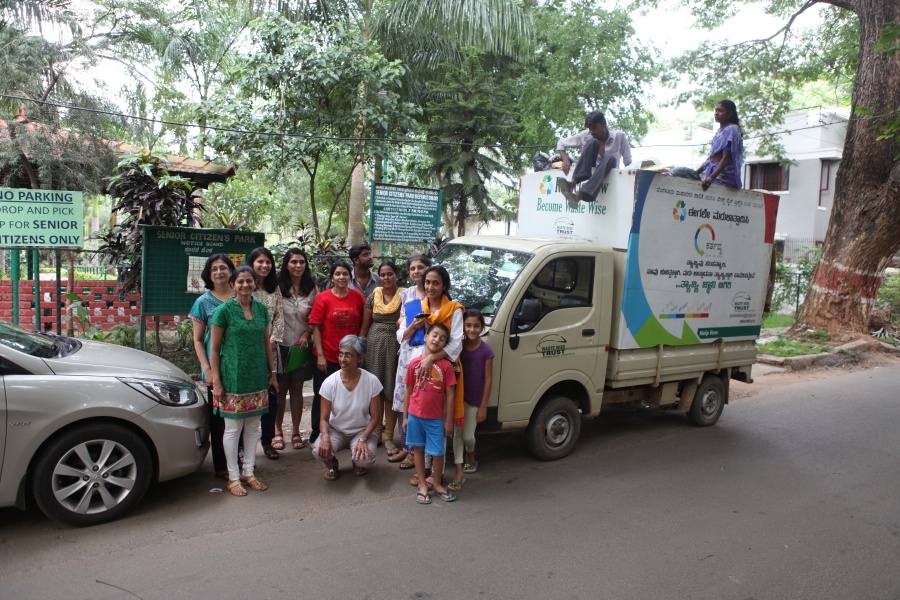
From Left to right: ABC, XYZ

Def. Colony’s Motley Crew of Waste Managers, from left to right: Annie Thomas, Smita Shah, Rakhee Pankaj, Jyoti Kalapa, Sumati Prabhakar, Ambedkar, Agnes, Asha Muthanna, Namrata Mundhra (& kids)
Seated: Mich Gupta
On the bus: Rafiq

Genesis of the Dry Waste Program: In October 2012, the Bangalore Municipal authority (BBMP) announced new “rules” (ha!) for waste segregation and disposal. A small group of volunteers met with the BBMP health inspector to understand these rules so we could educate residents about what they needed to do to be in compliance. It did not take long for us to realize that nothing was going to change as the BBMP staffers and contractors continued to go their merry way. Rather than wait, a small group of us decided to take matters in our own hands. We focused initially on recyclable waste for 2 reasons:

  1. Most residents already segregate some of their recyclables – think newspapers and bottles – so we didn’t really have to create an entirely new habit – just piggyback on to an existing one.
  2. Back-end processes for recycling were also fairly well established – India has a network of kabadiwallahs, scrap-dealers, rag-pickers, etc. who already make their livelihood by recycling waste. So we were fairly confident that if we could figure out a process to collect segregated dry waste, we could recycle it.

To cut a long story short, we decided to partner with the RecycleGuru, an initiative of the Daily Dump (organization that focuses on composting products) to help us manage dry waste collection (since March we are working with the Domlur Dry Waste Recycling Center (DWCC) since they were much better position to handle large volumes)

This is when we began running into challenges and constraints. I describe below each hurdle we faced and how we managed to get around it.

1. It takes one bad apple to spoil the bunch: Residents that segregated at home, gave their waste to their domestic staff to dispose into common bins. Even if the home or apartment building had different bins for dry and wet waste – it took one careless person to dump organic waste into the dry waste container and contaminate everything.

What we did: We asked all households, even apartments to hold their waste at home and let our collection staff pickup. This door-to-door pickup added substantially to the time involved in collection but it also allowed us to ensure we got actual recyclable waste and not just garbage. This also allowed us to flag residents who were not segregating correctly so we could go back and talk to them about what they need to do differently. We also talked to the domestic workers and security guards during collection to educate them about the process. Today they are a very important element in helping us manage a smooth and efficient collection.

2. Show me the money!  The people doing your waste collection (assuming it is not the municipality) need to recoup their cost of collection in some way. Each collection requires a small truck, fuel, 1 driver and 1 collector/loader – the approx. cost of which is about INR 600-800 for a half day. And this does not take into account any profit the waste collection folks need to make so the effort is actually worth their while. Since DECORA didn’t have any spare funds to actually pay for collection and there was no way to impose and collect a separate dry waste fee on residents (particularly if we wanted the program to survive), we had to find some way of financing collection costs.

What we did: We asked people to pay for collection by giving us their high-value dry waste. Newspapers, magazines, milk packets, cardboard, glass bottles, metal are all higher value waste. If we got enough high-value dry waste, we could subsidize the collection of low value waste such as scraps of paper and plastic.

3.     People do want to have their cake and eat it too: Unfortunately this is where past habits worked against us. Many residents were used to selling their newspapers, and other high-value waste for some small amount and did not want to give that up. Some residents gave away their recyclables to their domestic staff and let them keep the proceeds from selling to the local kabadiwalla. Others donated their newspapers to charities such as the blind school in our neighborhood. If people opted out of giving us their high-value waste and we ended up with only the low-value – our collection partners would have no incentive to run the program for us. This really stumped us for a while.

What we did: The DECORA dry waste team volunteers went house to house to explain the program, costs of running the program and its benefits to residents. Initially we offered residents the option of either getting paid for their recyclables or donating proceeds to DECORA to help us fund collection. In our communication with residents we also stressed that the proceeds from our waste were helping small entrepreneurs who eked out a livelihood by managing our waste (appealed to their altruism to give up longstanding habits). Our volunteers were all residents who were passionate about the program and had strong ties to the community – with their help, we managed to get 85% of participants who signed up to give us all their recyclables and donate proceeds. For the ~15% of the participants who chose to get paid, we made sure we weighed and paid for their dry waste at time of collection so they still felt they had a choice. Since March 2013 we have transitioned out of this system – nobody gets paid but the program is completely self-funded (no fees, no funds from DECORA and no donations!).

4.     It’s not just a waste management problem, it is a change management problem: We started dry waste collection with a small group of DECORA volunteers going house-to-house along with our collection partners. Our goal was to phase ourselves out and let the collection folks take over in a couple of months. What we realized however, that most people were doing their bit because of us – their neighbors and friends. Given the general dysfunction around waste management in Bangalore, it is so easy to believe that no such new program will ever work. So it is valid for residents to think: why make the effort when it is bound to fail?

What we did: We expanded our group of volunteers (from 4 to 8), divided up the collection day into shifts of 1 to 1.5 hours each, and after a few months changed the frequency of collection from weekly to fortnightly so we could continue to run a volunteer-driven program. When residents saw us at their home every 2 weeks and realized we were not going away – they started making an added effort to segregate and hold their waste. Initially people pushed back about holding on to their dry waste for 2 weeks but our experience in the first couple of months had already demonstrated that most people do hold most recyclables for at least 2 weeks if not longer – what they object to is holding on to the bits and pieces of low-value dry waste and stuff that can attract pests like milk packets. But since the volunteers (their friends and neighbors) were asking they were willing to give it a try. And within a few weeks, most people had figure out their own system for holding their dry waste. Whether it is guilt, shame or trust – we were quite happy to use it to our advantage to ensure sustainability of this program.

5.     Nothing succeeds like success:  The pilot (of about 3 months) mostly included people the volunteers knew personally. Many other residents sat on the fence for a while – knowing about the program but not willing to take the next step of participating since they believed that like everything else, this too would come to an end in 3 months.

What we did: We made sure we kept up the buzz – we sent 2 emails a week to the residents group (and yes, having a residents group on email made our job much, much easier) with an update about the program, statistics of waste collected, reminders of how simple segregation actually was, etc. We decided that it was not our job to bully residents into participating or even to assume that once a solution was available everyone would automatically start segregating. Instead we deliberately allowed the program to grow word of mouth while ensuring that we keep up the communications through whatever forum possible. We organized special collection drives for e-waste and medicines, asked residents to talk to their neighbors, and leaned on our personal networks. It’s been a trickle, never a flood but we have managed to grow from the 30 households we started with to over a 100 participating households that actively recycle.

6.     Keep an open mind, really! When we started we made several assumptions. We would need to do a weekly collection. People need to segregate into multiple categories. Volunteers should stand back and let the collection staff run the show. Young professionals who are aware of environmental issues will be the more active participants. Door-to-door collection will not work.

What we learnt: None of these assumptions were valid. And because the volunteers were actively involved in the process, we really got to learn first-hand what could be done differently. Today we collect every other Saturday. We ask residents to segregate in a way that they find most convenient (since the Domlur recycling center we now work with does further segregation anyway). We ask the volunteers to be front and center during collection (and we all also pick up waste along with our collection partners so even our collection partners feel we are part of the team). Several of our older residents who have actively recycled and reused all their life are our most responsible participants. As more residents sign up and take responsibility, in some cases we are able to move to collection from a common bin – but we still largely run a door-to-door collection since we are able to get both more dry waste and better segregated waste.

In conclusion, while we still have a long way to go, after all only 20-25% of our residents currently recycle, I do believe that this program is now on auto-pilot. And if I could pinpoint the one decision that made the greatest difference, it would be to run this with the help of volunteers. In the words of Margaret Mead, “Never doubt that a small group of thoughtful, committed citizens can change the world; indeed, it’s the only thing that ever has

Awful AIG lawsuit

Standard

I could hardly believe my eyes reading about the lawsuit AIG is contemplating against the US government. As Dan Primack called them “Arrogant InGrates”. I recently finished reading “Too Big to Fail” and even there I was struck by the absolute hubris of the executives who screwed up so big and yet showed no sense of responsibility. At the time the US government offered the bailout money, the CEO of AIG was reported to have said with a smile “They blinked” !! In essence, save us or we will take the whole system down. It really looks like it is going to take a very long time for the “Wall St. Culture” of making a buck at any cost to go away and be replaced with some sense of responsibility and good ethical behavior. The entire synthetic CDOs was just a simple Ponzi scheme and to think that supposedly intelligent people making millions of dollars would allow it to happen is just depressing. No product got created, no innovation around better capital allocation, nothing; just different ways to move money around so that the bankers could take a cut along the way. What a bloody waste of talent.

Grokking India: High fixed cost per transaction

Standard

This blog post is really worthy only of a tweet since the core lesson is simple and either you grok it or you don’t; either you believe it or you don’t. There really is little middle ground.

I have previously written about hidden costs of starting up a business in India, I’ve written about accounting for cost of collections in calculating LTV and I have written about the unique challenges in building a distribution network in India. The common theme, the underlying economic fact of India, is as follows:

EVERY TRANSACTION HAS A HIGH FIXED COST

OK, that’s all I have to say. Thank you for reading.

Juuuust kidding! This idea is very important to understand and in the context of VC funded companies has a non-trivial impact on capital requirements, scalability and therefore returns. Let me re-hash a few examples I have given previously to explain this further:

  1. As you go from B2B to B2B2C (FMCG) to B2C, the revenue per transaction keeps decreasing, but after a point the fixed costs per transaction (cost of collections, returns, customer service, defaults, high friction courier etc) do not go down. Therefore unit profitability and/or scalability on B2C continues to be a challenge. B2B2C (FMCG companies) are big and hugely profitable and it is no surprise that their collections and deliveries are to consolidators of volume and therefore they are able to profitably pay for the fixed cost per transaction.
  2. VC investments in internet businesses have to be thought about like it is ’94 in the US. The early stage bets are big even to just prove out the concept because like in ’94 in the US, companies have to first build their operating eco-system in order to even validate their ideas. Borrowing the present-day methodology in Silicon Valley of doing $250K experiments in more cases than not will not tell you anything in India. In other words there is a high fixed investment amount for early stage transactions.
  3. Lack of trust: Consumers trusting businesses, citizens trusting laws and law enforcement, businesses trusting each other – due to systemic issues India is characterized by low trust and that almost always requires face-to-face contact and physical access to close all kinds of transactions. Even business transactions require much higher level of diligence due to worries of being cheated. This is again HIGH fixed cost for many different kinds of transactions.

And the list goes on.  Analyzing the sources of the fixed costs can tell you what needs to be done to reduce the fixed costs. And there you find all the usual suspects, for example:

  1. Electronic payment systems need to be in place (to completely “variablaize” cost of collections)
    • which in turn require consumer trust
      • which in turn require reliable credit agencies
        • which in turn require trustworthy laws and law enforcement
    • OR you can build a telecom company that does electronic payments. A telecom company has the consumer’s trust and obviates the need for an EXTERNAL credit agency or good law enforcement around payments (Put it another way: the fixed cost of building a national level electronic payment network is building a telecom company!).
  2. Better infrastructure: good roads (reduced fixed costs of transportation),  good power systems (reduce fixed cost of operations), etc
  3. Trustworthy law enforcement so that there is implicit trust in legal contracts

These fixed costs are worth reducing as they have non-trivial implications, including:

  1. Unleashing innovation as cost and risks of experimentation goes down; with high fixed costs experimentation becomes tougher
  2. Improving investor returns as the bets can be staged better
  3. Decreaing time to scale for ideas that show potential because lower fixed costs imply a “lower friction” operating environment

For all these reasons, India is, and will remain in the foreseeable future, an economy dominated by operational complexity not strategic complexity. The big question in India is HOW to get products and services to consumers not WHAT. In other words India is not demand constrained but supply constrained and keeping an eye on the fixed costs in the system can help navigate the complexities of doing business while staying true to needs of profitability, scalability and investor returns.

Professional Photography Is Dead. Long Live Professional Photography!

Standard

I did a post on Tiffinbox.org about what I think about the future of pro-photography. Here is a small excerpt from it:

“… never before have average consumers been exposed to this much high quality imagery – web, mobile, magazines, hoardings, blogs – you name it. The quality of images on Pinterest or Tumblr is just mind blowing. Sub-consciously consumers have developed a greater appreciation for good images.  … [Consumers] are coming to appreciate how difficult the art and craft of photography is. So when it comes to important life events (operative words being “important life events”), my prediction is that over the next decade pros will be hired in record numbers. Consumers will be spending in record amounts. 

Check out the full post on Tiffinbox.org here

Airtel Money is potentially revolutionary

Standard

This post also appeared on the VCCircle blog here

Airtel Money is the first time in 5 years that I have truly become excited about a payment solution for the India market. I think this can be revolutionary. At Canvera we have evaluated each and every payment type available in India and have looked at the end to end cost, scalability and reliability. We concluded that managing cash (not COD) and encouraging online payments through debit and credit cards was most suited for our business. Building our own payment network was by no stretch in our business plan so it was disappointing and costly to have to do it. But in the process we got insights into the unique challenges of a payments company and that is why as soon as Airtel Money came about, we realized the potential for it to completely change the landscape. Let me explain why.

USE CASES

Broadly speaking there are two specific use cases:

  1. FOR POST-PAID ACCOUNTS: Statements can potentially become like credit card statements where the telecom companies may be able to assign certain credit limits based on payment history, guarantees etc.
  2. PRE-LOADED ACCOUNTS: both pre-paid and post-paid accounts charge a certain amount for payments (this is what is being offered today).

Consumers would use their mobile phone to make payments just as credit/debit cards are used today and merchants such as Canvera sign up to receive payments.

TELECOM COMPANIES ARE UNIQUELY POISED TO PULL THIS OFF

In evaluating the different payment solutions in India we understood some of their limitations. These included:

  1. Lack of consumer trust in the instrument: as a merchant we felt that we would have to support a number of payment options none of which had any significant traction. In fact in some cases we felt that we would need to build that trust in our customers and got in to talks with a few of the payment companies but eventually dropped the idea
  2. Lack of distribution capabilities: distribution at scale is possibly the minimum requirement to building trust. But more than that the payment method needs to be easily accessible and all use cases around the instrument need to be simple. A lot of the alternate payments services failed on this front.
  3. Convenience: A lot of the payment solutions had just too many steps for the consumer that there was no way that average consumer was going to use these solutions regularly. Some of the issues stemmed from regulation and were out of control of the payment company but the net result was that they asked too much of the consumer.

The telecom companies are uniquely poised to overcome these challenges. They already are known brands and have trust of the consumer; and they have significant distribution capabilities to provide physical touch points for payments, re-charges, customer queries, issue resolution etc.  No startup can quite compete with the investments that telecom companies have made in establishing their reach and brand.  And finally the convenience of paying with a mobile phone – who can top that!

HURDLES

They are of course many hurdles. The two key ones are:

  1. NEW PRODUCT & SERVICE DEVELOPMENT: Can the telecom companies truly create an internal environment where a brand new product and service offering can be developed, improved and deployed at scale? As a merchant I sure hope so, but it is a challenge nevertheless. This new product /service development will require a completely new mindset and skills while leveraging the power of the present infrastructure of the telecom company.
  2. REGULATORY: Will the telecom companies be allowed to essentially become banks providing credit to consumers? Again, my hope is that this will be allowed, with appropriate but minimal regulation to protect consumers. Given the clout telecom companies have within the government, no one else is better poised to lobby the forces-that-be to make this happen.  Certainly no startup can develop that level of clout and reach within the government.

While I don’t want to trivialize the above two challenges, I do feel that compared to the challenges in front of a payment startup these are surmountable in a “reasonable” time frame and if overcome can very quickly change the payments landscape in India.

In addition to allowing the new product and service to be developed fully I do also hope that telecom companies learn the lessons from the mVas debacles that by taking too much away from the innovators they actually kill the innovation. I hope that they will learn to play the role of a neutral and cost effective platform and not compete or interfere with the free market competition between the merchants.  Done correctly this can potentially even correct the ARPU issues that telecom companies face in India.

SERVING LONG TAIL NEEDS

India is a country of great diversity and yet, due to number of structural issues, it is virtually impossible for a single service provider to PROFITABLY service the very long tail of consumer preference. A key enabling piece (amongst many others) to serving the long-tail needs is an electronic payment network that allows merchants to profitably collect small amounts of money. The low penetration of credit cards and lack of growth, lack of trust in the infrastructure and law enforcement , the challenges to create a national credit rating system etc meant that solutions that have worked in developed markets will take decades to reach scale in India. A telecom company also becoming a payments company and being able to provide credit can dramatically shorten the timeframe to achieve the same result.  A unique solution to a unique operating environment that could potentially unleash long tail creativity.

I am rooting for this one!

Distribution Is King. Much More So In India

Standard

This post first appeared on the VCCircle blog here

————–

The easiest way to tell if a PE/VC investor has earned their chops in India or in the west is when within 15 mins of your conversation the former will ask you: “Now that you have created your distribution network in India (or plan to create it) what else beyond your present offering can you pump through it?” This test has never failed me! There is a lot of wisdom behind this bias because the toughest thing to do in India is to build out the distribution network. A US trained VC’s bias will be towards vertical growth within the same product suite, but an India trained VC will have a bias towards horizontal growth across multiple product suites. I would argue that the challenges of distribution are so huge in India that product innovation is secondary and it is more capital efficient to “import” products and figure out the distribution network rather than spend time and energy on innovation.

Today we are seeing an angel investing boom in the US. There is a lot of infrastructure in place that allows this to happen. Amazon Web Services and the ilk are often mentioned as the key enablers but what does not get mentioned as often are: variabalized sales/marketing costs through online marketing; reliable physical infrastructure; reliable courier services; an electronic payments network; trustworthy law enforcement; overall high level of trust in society etc. All these are different elements of distribution that have on a relative scale commoditized distribution for an entrepreneur so that she and her team can focus on the core product. In essence, it has freed up a lot of energy to focus on pure innovation.

In this post, through a comparison to the US market, I will simply highlight the unique distribution challenges of India. The key to success in India is to be aware of these challenges and develop plans to work within the constraints they force upon you. With present-day low levels of per-capita consumption, domestic consumption in India will continue to grow for decades and companies that address the India market at its own terms rather than following copy-cat business models are the ones that are going to capitalize on this growth.

Let me start with listing down the various elements of a successful distribution channel. I would say that the distribution channel for a brand has been setup if ALL of the following have been accomplished:

  1. TRUST: Consumers and channels have basic trust in the brand to try it out repeatedly and recommend it to others
  2. RELIABLE DELIVERY: The company has the ability to deliver the product/service reliably day in and day out
  3. ABILITY TO COLLECT: The company has the ability to collect money, which also includes ability to enforce a financial obligation (hopefully through legal means!)
  4. PROFITABILITY: At its simplest, this measures the firm’s ability to charge the right amount and the operational efficiency of the channels to keep costs down.
  5. SCALE: The business needs to have reasonable scale – exact revenue numbers will depend on the type of business, but north of $5-10M is a good first order estimate in the context of a VC- funded company

So let’s compare the challenges on all of these fronts between India and US.

TRUST

Any time a new company is formed there is resistance to accept the new product or service and overcoming this through great delivery, marketing, sales etc costs a lot of money in every country. But a major issue in India is the low level of trust that exists in businesses due to daily poor experiences. Think of your favourite home service (plumbing, electrician, car repair) or banking services (“I will call you back tomorrow” – yeah right!) or horror stories getting medical care – the default starting point for the consumer is to assume “it will not work” or “s/he is lying or stretching what’s actually possible”. A consumer starts with a position of mistrust and then trust has to be earned. It is the exact opposite of what happens in the US. If I wanted to buy an expensive camera in the US, I would do a Google search, quickly find the best price and place the order. There is a 99% guarantee that the product I ordered will get delivered in the time committed and that I will have full protection for the 1% of the time there is a problem. I’d walk in to brand new restaurant on day-1 without any fear of falling sick.

In India, overcoming the very high level of mistrust at scale is at best extremely expensive and at worst takes a lot of time and staying power. It requires delivery at scale (which is a chicken and egg problem), advertising, marketing & sales at scale, and good corporate behavior at all company touch points.

RELIABLE DELIVERY

The concept of “reliable” delivery means many different things in different businesses but let me take Canvera’s example of delivering photographic printed products to customers. We work closely with 15+ courier companies (not 2 or 3, but 15) that deliver mail-order product to 300+ cities. Over a 4 year period we have developed intricate processes to monitor each packet over and above the monitoring and tracking the courier company provides because in the end it is our responsibility to deliver the packet in a respectable timeframe and through experience we’ve learnt that we can’t rely on the courier companies. In a services business (think restaurants) in India scaling up is a huge challenge because of the quality of the available workforce and the training required (think hygiene in a restaurant). In the US, courier services are a given, no entrepreneur worries about them.  And while finding high quality workforce in a services business is always a challenge, the size of the US economy itself provides a reasonably large trained workforce. It may cost a pretty penny, but it is available. Think of how quickly Groupon scaled its team of Inside Sales to 1000s of people and how many different businesses were able to reliably provide the services to consumers through Groupon.

ABILITY TO COLLECT

I have written at length about COD in an earlier post – that was more in the context of a B2C business. But there are other forms of collections including B2B, retail etc. FMCG businesses in India manage consumer collections by offloading them to the kirana store and managing their own collections from the store owner by creating enough demand for the product and holding back supplies if payments are not received. B2B collections are a nightmare in India that create massive cash flow issues with providers being forced to get in to the credit business since there really isn’t a legally enforceable collections framework and companies rely on personal relationships and holding back future services to enforce payments. No entrepreneur I know of in the US worries about collections as a bottleneck to business growth. It is a plug and play solution and largely a variable cost with a legal framework to fall back on.

PROFITABILITY

Let’s examine the two aspects of profitability: Revenue and Cost. Take mail order businesses (or e-commerce);  consumers in the US are willing to pay a little extra for shipping solely for the convenience – as the economy has grown and time becomes a premium, there is an appreciation for opportunity cost and value based services that save time and headache. On the cost side – assuming healthy gross margins, given a reasonable cost of RELIABLE shipping and reasonable cost of collections, each transaction can be profitable in the US. In India however it is a very big assumption that consumers will pay for convenience (this is a separate blog post altogether) – real and perceived opportunity costs are low and even if they increase, it takes a lot of time for consumer behavior to change at scale. So far, especially in e-commerce, all we have seen is what we know sub-consciously: price is all that matters. I am willing to bet that volumes will drop dramatically if Indian e-commerce companies start charging nominal amounts for shipping or if prices are raised to even a few % points higher than offline retail. And then on the cost front, as I have mentioned before, cost of collections is high and logistics are very inefficient. The combination of not being able to charge for convenience/quality and a high friction operating environment results in highly unprofitable transactions.

SCALE

Finally, any company can overcome all of the above at a small size, the real challenge is being able to do this on a large scale: in multiple geographies, in multiple languages all over India.

ignore underlying infrastructure at your own risk

Telecom companies are the best example of the power of distribution networks in India. This blog post by Abhimanyu Radhakrishnan summarizes it best:

The speaker line-up at the opening keynote … is the best evidence possible of the peculiarity of the mobile phone industry. The operator – the guy who provides you an easily commoditized, utility like service – has the biggest clout in the industry. Imagine the premier global conference for …umm… ‘Home Appliances’ having the CEOs of the electricity companies as the big draws.

How true! And yet the power is with the phone company because they have the distribution network. They have the trust of the consumer; they provide mVas players with a reliable delivery and collections mechanism which can in turn be profitable. And they have significant scale. No telecom player wants to be seen just as the dumb pipe. After having put in the capital and time to build out this network, they want a share of every innovative product that is distributed through it. It is a separate matter that their behavior and expectations are preventing innovation but the bargaining power is clearly in their hands (Side note: telecom companies are behaving like an investor in a capital constrained market who wants to invest at $0M pre-money. I digress).

This discussion is by no means suggesting that it is easy to build a business in a developed market or impossible to do it in emerging markets like India. In fact, the barriers of distribution that have been lowered in developed markets are lowered for all the entrepreneurs and therefore competition can be much higher as well. Product innovation and speed then become key differentiators.  India is unique; India is not the US, nor is it China or Brazil. In India FMCG companies have shown how a leveraged offline model of using kirana stores to offload a lot of these distribution costs and last mile headaches can lead to big defensible, scalable and profitable businesses. There is much to learn from these success stories.

The one cautionary fact for all entrepreneurs and investors to note is that TIME is the biggest price to pay for the lack of infrastructure. It is extremely difficult to overcome the barriers through just capital. There are no shortcuts and setting up the foundation correctly is absolutely critical to building defensible scale. It has been done, it IS being done and my money is behind the people who are keeping their eyes open to these challenges.

Why I don’t believe in COD

Standard

This post first appeared on the VCCircle blog here.

—–

Payment systems (or lack of them) are a very big problem for India e-commerce and as much as COD is being touted as the panacea to get over the hurdles of reach and consumer trust, I am just not able to buy the story. To me it seems like optimizations to COD are like trying to make the horse run faster while what we need is an automobile (sorry Henry Ford!). Stretching the analogy, we not only need the automobile, we also need the support infrastructure of petrol bunks, repair shops, credit agencies etc. The equivalent of the automobiles in payments are well penetrated and reliable electronic payment systems, which in turn require good credit rating agencies, trust worthy law enforcement etc. A very tall order to achieve in a few years when there is generally low trust, low penetration and insipid growth if any (credit card penetration is stuck at 20M for last few years) of electronic payment systems.

I am firmly in the camp of people who believe that the e-commerce bubble is going to burst soon and while I think there are many fundamental reasons why this will happen, if you forced me to pick only one I would pick lack of electronic payment systems in India.

Before I explain any further, let me state two key assumptions:

  1. I am primarily talking about COD in the context of high volume, low gross margin (<Rs1000) products
  2. I am assuming that mid-term profitability is important

If both these assumptions don’t apply to a business then you can ignore my analysis.

Sources of Fixed Cost in COD

I explained the LTV impact of COD in a previous post. Let me expand on this further and list down the sources of fixed cost per collection:

  1. Cost of physically traveling to collect money: Number of trips that need to be made to collect the money and the cost of these trips especially given high petrol prices
  2. Cost of consumer changing their mind: If the money is not charged immediately when the consumer is in the buying window, large % will change their mind when the order is delivered (anecdotally I have heard 30% “return” rates being quoted in the industry today)
  3. Cost of managing cash and reconciliation: This requires people based processes to count, store and deposit money in the bank in addition to manually reconciling the money with the right order
  4. Fraud: This has many sources, including the collections person running away with the money, fake currency notes, collusion between  the collections team, law enforcement issues with someone carrying significant cash etc.
  5. Hiring, re-hiring, training and management of the collections team. This will be a huge fixed cost borne by the company

All of these translate to a FIXED COST PER TRANACTION, regardless of the money being transacted. Just this fact can make the business unprofitable unless, and this is important, that the cost of collection can be completely “variabalized”. There is no other way to do this except to switch to a completely electronic payment system.

Scalability challenges

And finally, there is the scale challenge. If the GMV value (not revenues – and can we please stop calling GMV revenues, it discredits everyone in the startup eco-system!) of e-commerce transactions in India is to reach $1B annually (so ~$100M in revenues) and the average GMV value is $20 then we need 50M transactions – even if 60% of these are based on COD, it means 30M transactions of $20 at a time being handled and reconciled by people. Let me say it again, for $100M in revenues there will be 30M POPLE-BASED transactions to collect and reconcile the money. There will be management layers to manage the team, hiring and retention (and replacement will be an issue) as the company will require low-skilled workers to try and make the math work. A rudimentary calculation assuming 6 collections per person per day means that the front-end collections team will have to be of about 15,000 people and probably half the size of this team to do the backend operations. Most of the front end team will probably earn Rs5-7K/month. To keep a reliable force out in the field (not in a factory where it is easier to manage a team) there will be significant management overhead and constantly having a pipeline of 10-20X  the team strength (i.e. 150K-300K people) for replacements. Then there are the costs of career planning and growth for this work force.

It just is really hard to see how this will work when transactions gross margins are low and nothing that I have heard or seen in the last 9 months of this bubble is able to convince me otherwise. The COD payments business is a services business and in order for the math to work, it needs to quickly transform to a products business, i.e. be replaced by an electronic payments system. That will take a lot of time. A.Lot.Of.Time.